
EVENTS
FORENSIC SYSTEMS IN ACTION (FSA): Humanizing Legal and Correctional Systems Through Action Methods

DATES:
Nov 4 · Dec 2 · Jan 6 · Feb 3 · Mar 3 · Apr 7 · May 5 · Jun 2 · July 7 · Aug 4, 2027
TIME:
Pacific Time (US): 8:00–10:00 AM
Mountain Time (US): 9:00–11:00 AM
Central Time (US): 10:00 AM–12:00 PM
Eastern Time (US): 11:00 AM–1:00 PM
Central European Time: 5:00 PM - 7:00 PM DURATION: First Wednesdays | November 2026 – August 2027 LANGUAGE: English; Translated Captions Available COST: Full 10-Session Program
Single-Session Registration
Scholarships and Country Band Discounts
For information about partial scholarships and country band discounts, please contact the Tele’Drama Office at:
zoomroom.international@teledrama.org
Mountain Time (US): 9:00–11:00 AM
Central Time (US): 10:00 AM–12:00 PM
Eastern Time (US): 11:00 AM–1:00 PM
Central European Time: 5:00 PM - 7:00 PM DURATION: First Wednesdays | November 2026 – August 2027 LANGUAGE: English; Translated Captions Available COST: Full 10-Session Program
- Professionals & General Public: $999
- Current Tele’Drama Trainees: $899
- University Students & Retired Professionals: $799
Single-Session Registration
- Professionals & General Public: $119
- Current Psychodrama Trainees: $104
- University Students & Retired Professionals: $95
Scholarships and Country Band Discounts
For information about partial scholarships and country band discounts, please contact the Tele’Drama Office at:
zoomroom.international@teledrama.org
Forensic Systems in Action:
Humanizing Legal and Correctional Systems Through Action Methods
An international 10-Session Tele’Drama-based training for professionals in trial law, forensic mental health, witness work, and corrections.
PROGRAM TEAM
The program team consists of experienced psychodrama practitioners and trainers with extensive backgrounds in psychodrama, sociodrama, axiodrama, role theory, and role training. In addition, the team includes specialists in forensic psychiatry, forensic psychology, trial law, vulnerable-witness work, child-witness interviewing, prison-based rehabilitation programs, and post-release resocialization.Together, the team brings a rich integration of clinical, legal, educational, and experiential expertise. Each member also maintains strong professional ties with Tele’Drama International, contributing to the program’s commitment to innovative action methods in both virtual & hybrid environments.
Program Director:
Daniela Simmons, PhD, TEP - United States
Program Team: (alphabetically)
David F. Moran, LCSW, CADC, TEP – United States
Erica Hollander, JD, PhD, TEP – United States
Hande Karakılıç Üçer, MD – Türkiye
Leigh E. Johnson, JD, TEP – United States
Svetlana Iloski – North Macedonia
WHO IS THIS PROGRAM FOR?
This program is designed for:
Session 1 — Introduction: Action Methods in Forensic Contexts
Why experiential methods matter in legal and forensic systems. Ethics, boundaries, and safety. The roles that exist within justice settings.
Session 2 — Understanding Crime Through Roles and Systems
Role theory applied to crime, conflict, and harm. Sociodrama exploring offender, victim, and community systems.
Session 3 — Trauma, Stress, and Human Behavior Under Threat
How trauma affects decision-making, behavior, and communication. Experiential exploration of trauma-informed roles.
Session 4 — Vulnerable Witnesses and Effective Communication
Supporting clarity, memory, and safety. Role training for communication with children and vulnerable witnesses.
Session 5 — Courtroom Roles and Legal Dynamics
Judge, jury, attorney, defendant, and witness. Pressure, persuasion, conflict, and role demands. Psychodramatic exploration of courtroom scenes.
Session 6 — Forensic Psychiatry in Action
Mental illness and legal responsibility. Competency, insight, risk, and role functioning. Experiential exploration of psychiatric roles within justice systems.
Session 7 — Working Inside InstitutionsPrison roles and institutional culture.
Power dynamics, alliances, and survival roles. Sociometry in closed systems.
Session 8 — Reintegration and Resocialization
Role transitions after incarceration. Family and community dynamics. Identity rebuilding through role training.
Session 9 — Restorative Approaches and Community Repair
Victim, offender, and community dialogue. Responsibility, accountability, and empathy. Axiodrama exploring justice and ethics.
Session 10 — Final Experiential Integration
Large-group action learning. Case-inspired exploration. Reflection, insights, and practical applications.
Humanizing Legal and Correctional Systems Through Action Methods
An international 10-Session Tele’Drama-based training for professionals in trial law, forensic mental health, witness work, and corrections.
PROGRAM TEAM
The program team consists of experienced psychodrama practitioners and trainers with extensive backgrounds in psychodrama, sociodrama, axiodrama, role theory, and role training. In addition, the team includes specialists in forensic psychiatry, forensic psychology, trial law, vulnerable-witness work, child-witness interviewing, prison-based rehabilitation programs, and post-release resocialization.Together, the team brings a rich integration of clinical, legal, educational, and experiential expertise. Each member also maintains strong professional ties with Tele’Drama International, contributing to the program’s commitment to innovative action methods in both virtual & hybrid environments.
Program Director:
Daniela Simmons, PhD, TEP - United States
Program Team: (alphabetically)
David F. Moran, LCSW, CADC, TEP – United States
Erica Hollander, JD, PhD, TEP – United States
Hande Karakılıç Üçer, MD – Türkiye
Leigh E. Johnson, JD, TEP – United States
Svetlana Iloski – North Macedonia
WHO IS THIS PROGRAM FOR?
This program is designed for:
- Psychologists (clinical, counseling, community)
- Psychodramatists and action-method practitioners
- Social workers
- Mental health professionals
- Attorneys and legal professionals
- Law students and legal trainees
- Forensic psychiatrists / forensic psychologists in training
- Students in psychology, social work, criminal justice, law, or related fields
- Professionals working with vulnerable populations
- Correctional and rehabilitation specialists
- Professionals working with victims, witnesses, offenders, or families
- Crisis workers and community-safety teams
- Educators and researchers in justice, trauma, and legal psychology
Session 1 — Introduction: Action Methods in Forensic Contexts
Why experiential methods matter in legal and forensic systems. Ethics, boundaries, and safety. The roles that exist within justice settings.
Session 2 — Understanding Crime Through Roles and Systems
Role theory applied to crime, conflict, and harm. Sociodrama exploring offender, victim, and community systems.
Session 3 — Trauma, Stress, and Human Behavior Under Threat
How trauma affects decision-making, behavior, and communication. Experiential exploration of trauma-informed roles.
Session 4 — Vulnerable Witnesses and Effective Communication
Supporting clarity, memory, and safety. Role training for communication with children and vulnerable witnesses.
Session 5 — Courtroom Roles and Legal Dynamics
Judge, jury, attorney, defendant, and witness. Pressure, persuasion, conflict, and role demands. Psychodramatic exploration of courtroom scenes.
Session 6 — Forensic Psychiatry in Action
Mental illness and legal responsibility. Competency, insight, risk, and role functioning. Experiential exploration of psychiatric roles within justice systems.
Session 7 — Working Inside InstitutionsPrison roles and institutional culture.
Power dynamics, alliances, and survival roles. Sociometry in closed systems.
Session 8 — Reintegration and Resocialization
Role transitions after incarceration. Family and community dynamics. Identity rebuilding through role training.
Session 9 — Restorative Approaches and Community Repair
Victim, offender, and community dialogue. Responsibility, accountability, and empathy. Axiodrama exploring justice and ethics.
Session 10 — Final Experiential Integration
Large-group action learning. Case-inspired exploration. Reflection, insights, and practical applications.
For partial scholarship opportunities contact zoomroom.international@teledrama.org
or submit here
OTHER EVENTS IN Programs
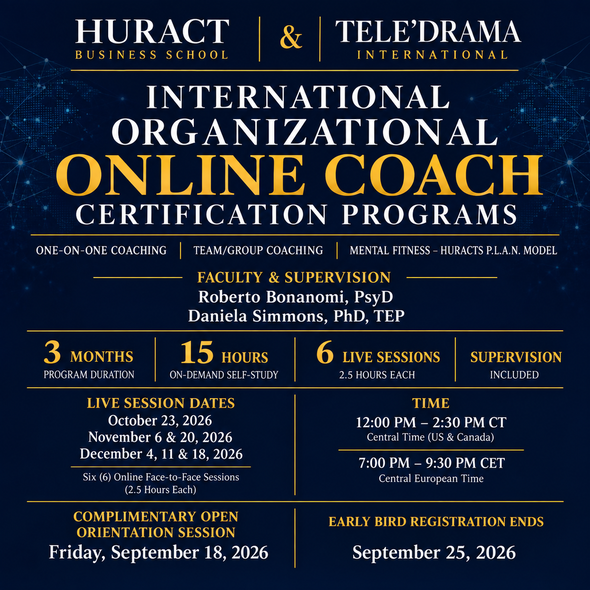
INTERNATIONAL ORGANIZATIONAL ONLINE COACH CERTIFICATION PROGRAMS: One-on-One Coaching • Team/Group Coaching • Mental Fitness HURACT’s P.L.A.N. Model
OCTOBER 23, 2026 NOVEMBER 6 & 20, 2026 DECEMBER 4, 11 & 18, 2026
3 MONTHS
Presenters: Daniela Simmons, PhD, TEP, Roberto Bonanomi, PsyD
Information & Registration
The Place Where the Waters Meet: Entering Our Knowing, Finding Stillness, Quiet, and the Wisdom of Both/And ; Encontrando la quietud, la tranquilidad y la sabiduría de “ambas cosas” y no solo “una cosa o la otra”.
TUESDAYS — NOVEMBER 3, 10, 17, AND 24, 2026
FOUR TWO-HOUR SESSIONS
Presenters: Leticia Nieto, PsyD, TEP, Andrea Wilches
Information & Registration
M.E.A.L.S. Online Certification Program in Eating Psychology, Psychodrama, and Other Experiential Applications
MONDAYS, NOVEMBER 9, 16, 23, 30; DECEMBER 7, 14 ; JANUARY 4, 11, 18, 25
10 WEEKLY EXPERIENTIAL ONLINE SESSIONS (30 HOURS TOTAL)
Presenters: Colleen Baratka, MA, TEP, Gülşen Büyükşahin, MA, PAT, Tele'Drama Associate Trainer
Information & Registration

2027 PSYCHODRAMA, SOCIOMETRY AND GROUP PSYCHOTHERAPY TRAINING GROUP
FEB 7, FEB 21, MAR 7, MAR 21, APR 18, MAY 2, MAY 16, MAY 30, JUN 13, JUN 27, AUG 27, SEP 10, SEP 24, OCT 8, NOV 19, DEC 3, DEC 17, 2027
EVERY OTHER SUNDAY; 17 SESSIONS; 50 HOURS TOTAL
Presenters: Daniela Simmons, PhD, TEP
Information & Registration
Directing Sociodrama in the Virtual Space: Classical Morenian Structure with Contemporary Online Methods – A 5-Session Program
MAY 1, MAY 8, MAY 15, MAY 22, AND MAY 29, 2027
5 SATURDAYS IN MAY 2027 · TWO-HOUR SESSIONS EVERY SATURDAY · TOTAL 10 HOURS
Presenters: Daniela Simmons, PhD, TEP
Information & Registration
We make our Home Anew: Wings and other Displacement Gifts that Help Us Root into Refuge | Group Forming – GROUP FORMING – EXPRESSIONS OF INTEREST NOW BEING ACCEPTED
TO BE DETERMINED (TBD): THE GROUP WILL BEGIN ONCE SUFFICIENT INTEREST HAS BEEN RECEIVED AND PARTICIPANTS HAVE COLLECTIVELY SELECTED A MEETING SCHEDULE.
EIGHT 2-HOUR SESSIONS
Presenters: Miriam Zachariah, MA, TEP, Leticia Nieto, PsyD, TEP
Information & Registration
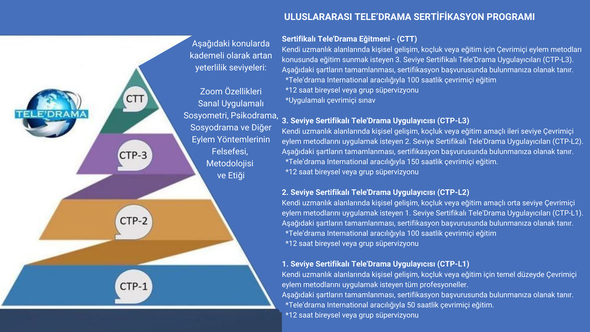
Tele’Drama Sertifikasyon Programı 1. Seviye Türkçe
GRUP, YETERLI üYE TOPLANDığıNDA BAşLAYACAKTıR
HER HAFTA çARşAMBA GüNLERI, 3'ER SAATLIK 21 OTURUM, EğITIM VE SüPERVIZYON/ TOPLAM 63 SAAT