
EVENTS
EMBODIED BUDDHIST PSYCHOLOGY & PSYCHODRAMA AND SOCIOMETRY IN CLINICAL PRACTICE

DATES:
Fridays: September 11; October 2; November 6; December 4, 2026
TIME:
07:00 AM – 09:00 AM Pacific Time (U.S. & Canada)
08:00 AM – 10:00 AM Mountain Time (U.S. & Canada)
09:00 AM – 11:00 AM Central Time (U.S. & Canada)
10:00 AM – 12:00 PM Eastern Time (U.S. & Canada)
11:00 AM – 01:00 PM Brazil & Argentina
03:00 PM – 05:00 PM UK (GMT/BST)
04:00 PM – 06:00 PM Central European Time (CEST)
09:30 PM – 11:30 PM India
11:00 PM – 01:00 AM Hong Kong, Taiwan, Singapore
12:00 AM – 02:00 AM (next day) Japan & South Korea
DURATION: 4 sessions • 2 hours each • Attend all sessions or any of them LANGUAGE: English; Translated Captions Available COST: Full Program (4 Sessions):
Professionals & General Public: $360
Psychodrama & Tele'Drama Trainees: $320
College Students & Retirees: $280
Single Session:
Professionals & General Public: $100
Psychodrama & Tele'Drama Trainees: $90
College Students & Retirees: $80
Payment by installment can be arranged upon request.
Please contact us at zoomroom.international@teledrama.org PRESENTER(S): Daniela Simmons, PhD, TEP
Jaye Moyer, LCSW, TEP, CTP-2
08:00 AM – 10:00 AM Mountain Time (U.S. & Canada)
09:00 AM – 11:00 AM Central Time (U.S. & Canada)
10:00 AM – 12:00 PM Eastern Time (U.S. & Canada)
11:00 AM – 01:00 PM Brazil & Argentina
03:00 PM – 05:00 PM UK (GMT/BST)
04:00 PM – 06:00 PM Central European Time (CEST)
09:30 PM – 11:30 PM India
11:00 PM – 01:00 AM Hong Kong, Taiwan, Singapore
12:00 AM – 02:00 AM (next day) Japan & South Korea
DURATION: 4 sessions • 2 hours each • Attend all sessions or any of them LANGUAGE: English; Translated Captions Available COST: Full Program (4 Sessions):
Professionals & General Public: $360
Psychodrama & Tele'Drama Trainees: $320
College Students & Retirees: $280
Single Session:
Professionals & General Public: $100
Psychodrama & Tele'Drama Trainees: $90
College Students & Retirees: $80
Payment by installment can be arranged upon request.
Please contact us at zoomroom.international@teledrama.org PRESENTER(S): Daniela Simmons, PhD, TEP
Jaye Moyer, LCSW, TEP, CTP-2
Directed by: Jaye Moyer, LCSW, TEP, CTP-2 & Daniela Simmons, PhD, TEP
Embodied Buddhist Psychology, Psychodrama & Sociometry in Clinical Practice
A 4-Part Workshop Series (2 hours each)
Attend the full series or individual sessions.
This series blends ancient contemplative wisdom with modern action methods, offering a powerful and integrated approach to clinical practice.
Buddhist psychology provides a creative and liberating lens for understanding life and its challenges.
Rather than viewing difficulties as problems to fix, Buddhist Psychology invites us to explore experience as a dynamic, unfolding process—shaped by perception, reactivity, habit, and awareness.
Buddhist psychology cultivates mindful awareness—the capacity to observe
experiences with openness and care.
Psychodrama gives that awareness form—allowing us to externalize inner
worlds, embody roles, and experiment with new responses.
Sociometry situates this work within the relational field—illuminating how we
influence and are influenced by, one another.
Together, they create a living practice where insight becomes action, and action deepens insight.
Workshop Series Overview
1. Mindfulness — The Foundation of Embodied Practice
Develop mindful awareness of body, heart, and mind as the ground for presence.
Cultivate the capacity to stay attuned, steady, and responsive in the midst of experiences.
Educational Frame:
Mindfulness (sati) as a way of relating to experience with clarity and non-reactivity.
Learning Edge:
Participants begin to recognize experience as process, not as identity.
2. The Hindrances — Working with Difficult Emotions Through Awareness
Explore the Five Hindrances as universal patterns of mind. Learn to turn toward difficulty with curiosity and mindful attention.
Educational Frame:
Hindrances are not obstacles to practice—they are the practice. They reveal how suffering is constructed in real time.
Learning Edge:
Participants shift from identification → relationship with difficult states.
3. The Brahma Viharas — The Embodied Heart Qualities
(Loving-kindness • Compassion • Joy • Equanimity)
Cultivate heart-centered capacities that support connection, resilience, and open presence in personal and relational work.
Educational Frame:
The Brahma Viharas are embodied relational capacities, not abstract ideals—we are training the heart.
Learning Edge:
Participants develop internal resources for regulation, connection, and resilience.
4. Transforming Reactivity into Response
Develop the ability to pause, reflect, and choose intentional actions. Integrate mindfulness, emotional awareness, and role flexibility.
Educational Frame:
Freedom emerges in the pause—when awareness and heart qualities inform action.
Learning Edge:
Participants practice transforming reactivity into wise, embodied responses.
Embodied Buddhist Psychology, Psychodrama & Sociometry in Clinical Practice
A 4-Part Workshop Series (2 hours each)
Attend the full series or individual sessions.
This series blends ancient contemplative wisdom with modern action methods, offering a powerful and integrated approach to clinical practice.
Buddhist psychology provides a creative and liberating lens for understanding life and its challenges.
Rather than viewing difficulties as problems to fix, Buddhist Psychology invites us to explore experience as a dynamic, unfolding process—shaped by perception, reactivity, habit, and awareness.
Buddhist psychology cultivates mindful awareness—the capacity to observe
experiences with openness and care.
Psychodrama gives that awareness form—allowing us to externalize inner
worlds, embody roles, and experiment with new responses.
Sociometry situates this work within the relational field—illuminating how we
influence and are influenced by, one another.
Together, they create a living practice where insight becomes action, and action deepens insight.
Workshop Series Overview
1. Mindfulness — The Foundation of Embodied Practice
Develop mindful awareness of body, heart, and mind as the ground for presence.
Cultivate the capacity to stay attuned, steady, and responsive in the midst of experiences.
Educational Frame:
Mindfulness (sati) as a way of relating to experience with clarity and non-reactivity.
Learning Edge:
Participants begin to recognize experience as process, not as identity.
2. The Hindrances — Working with Difficult Emotions Through Awareness
Explore the Five Hindrances as universal patterns of mind. Learn to turn toward difficulty with curiosity and mindful attention.
Educational Frame:
Hindrances are not obstacles to practice—they are the practice. They reveal how suffering is constructed in real time.
Learning Edge:
Participants shift from identification → relationship with difficult states.
3. The Brahma Viharas — The Embodied Heart Qualities
(Loving-kindness • Compassion • Joy • Equanimity)
Cultivate heart-centered capacities that support connection, resilience, and open presence in personal and relational work.
Educational Frame:
The Brahma Viharas are embodied relational capacities, not abstract ideals—we are training the heart.
Learning Edge:
Participants develop internal resources for regulation, connection, and resilience.
4. Transforming Reactivity into Response
Develop the ability to pause, reflect, and choose intentional actions. Integrate mindfulness, emotional awareness, and role flexibility.
Educational Frame:
Freedom emerges in the pause—when awareness and heart qualities inform action.
Learning Edge:
Participants practice transforming reactivity into wise, embodied responses.
For partial scholarship opportunities contact zoomroom.international@teledrama.org
or submit here


OTHER EVENTS IN Workshops

Beyond Peace: Sociodrama for Survival in an Uncertain World
SATURDAY, OCTOBER 24, 2026
3-HOUR
Presenters: Ron Wiener, PhD, Valerie Monti Holland
Information & Registration
AGING WELL: EMBRACING LIFE’S NEXT CHAPTERS - A Sociodramatic Exploration of Aging Across the Human Lifespan
SUNDAY, OCTOBER 25, 2026
2 HOURS
Presenters: Daniela Simmons, PhD, TEP
Information & Registration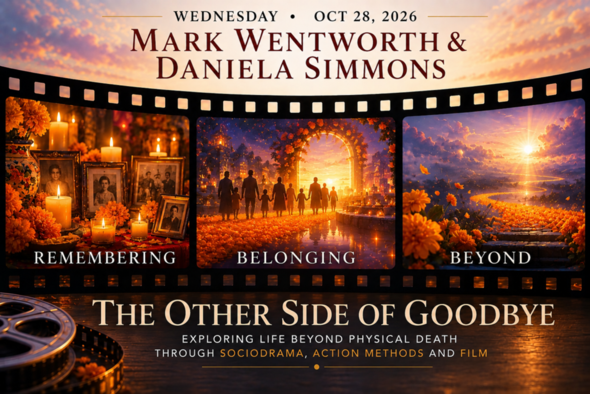
THE OTHER SIDE OF GOODBYE: Exploring Life Beyond Physical Death Through Sociodrama, Action Methods and Film
WEDNESDAY • OCTOBER 28, 2026
2 HOURS
Presenters: Daniela Simmons, PhD, TEP, Mark Wentworth
Information & Registration
Tired of Not Knowing: Healing Uncertainty Fatigue Through Psychodrama \ Monthy Series
FIRST WEDNESDAYS OF EACH MONTH, 2026 (FEB–DEC): FEBRUARY 4, MARCH 4, APRIL 1, JUNE 3, JULY 1, AUGUST 5, SEPTEMBER 2, OCTOBER 7, NOVEMBER 4, DECEMBER 2
10 MONTHS · 2 HOURS PER MONTH · ATTEND ALL OR ANY
Presenters: Daniela Simmons, PhD, TEP
Information & Registration
Exploring the Map of Grief™ Through Storytelling
SATURDAY, NOVEMBER 7, 2026
3-HOUR
Presenters: Ron Wiener, PhD, Cristina Hockl
Information & Registration
APPLIED PSYCHODRAMA SERIES: November 11: SOLILOQUY & ASIDE: Psychodramatic Techniques for Giving Voice to the Unspoken - From Ancient Theatrical Traditions through Moreno’s Theatre of Spontaneity to Contemporary Psychodrama Practice
SECOND WEDNESDAY OF EACH MONTH: NOV 11, DEC 9, JAN 13
MONTHLY 2-HOUR WORKSHOP | PARTICIPANTS MAY ATTEND ANY OR ALL OF THE SESSIONS.
Presenters: Daniela Simmons, PhD, TEP, Gülşen Büyükşahin, MA, PAT, Tele'Drama Associate Trainer
Information & Registration
e-Psychodrama International Personal Growth Circle: Online Group for Exploring and Healing Relationships
NOVEMBER 18, 2026
2-HOUR, FULLY EXPERIENTIAL PSYCHODRAMA SESSION ON THE THIRD WEDNESDAY OF EACH MONTH.
Presenters: Daniela Simmons, PhD, TEP
Information & Registration
Integrating Gottman’s Work and Psychodrama: From Dreams Within Conflict to the Art of Compromise
WEDNESDAY, DECEMBER 7 & 14, 2026
2 SESSIONS ON 2 CONSECUTIVE WEDNESDAY: JOIN ONE OR BOTH SESSIONS
Presenters: Daniela Simmons, PhD, TEP, Violeta Kadieva, PhD, LMFT-S
Information & Registration
BURNOUT RECOVERY & ROLE RECLAIMING THROUGH PSYCHODRAMA: Experiential Workshop
SUNDAY, TBD
2 HOURS
Presenters: Daniela Simmons, PhD, TEP
Information & Registration

ACTING THE UNCONSCIOUS: DREAM WORK THROUGH PSYCHODRAMA
TBD
2-HOUR
Presenters: Daniela Simmons, PhD, TEP
Information & Registration
Workshops Offered by Tele'Drama Practitioners & Trainers
VARIOUS DATES AVAILABLE
90 MIN | 3 HOURS